




Contemporary art
- Contemporary art in Colle di Val d'Elsa
Colle di Val d’Elsa and contemporary art: an original dialogue with the community. Discover a trail of works and installations perfectly integrated into the urban context.
Contemporary art in Colle di Val d'Elsa
A continuous dialogue between places and works of art
Art is not only a legacy of the past, but a commitment to be renewed in the present. Colle di Val d’Elsa is at the forefront of this commitment and upholds a mission rooted in attention to contemporary art and artists, in order to ensure the constant enrichment of the area’s artistic fabric.
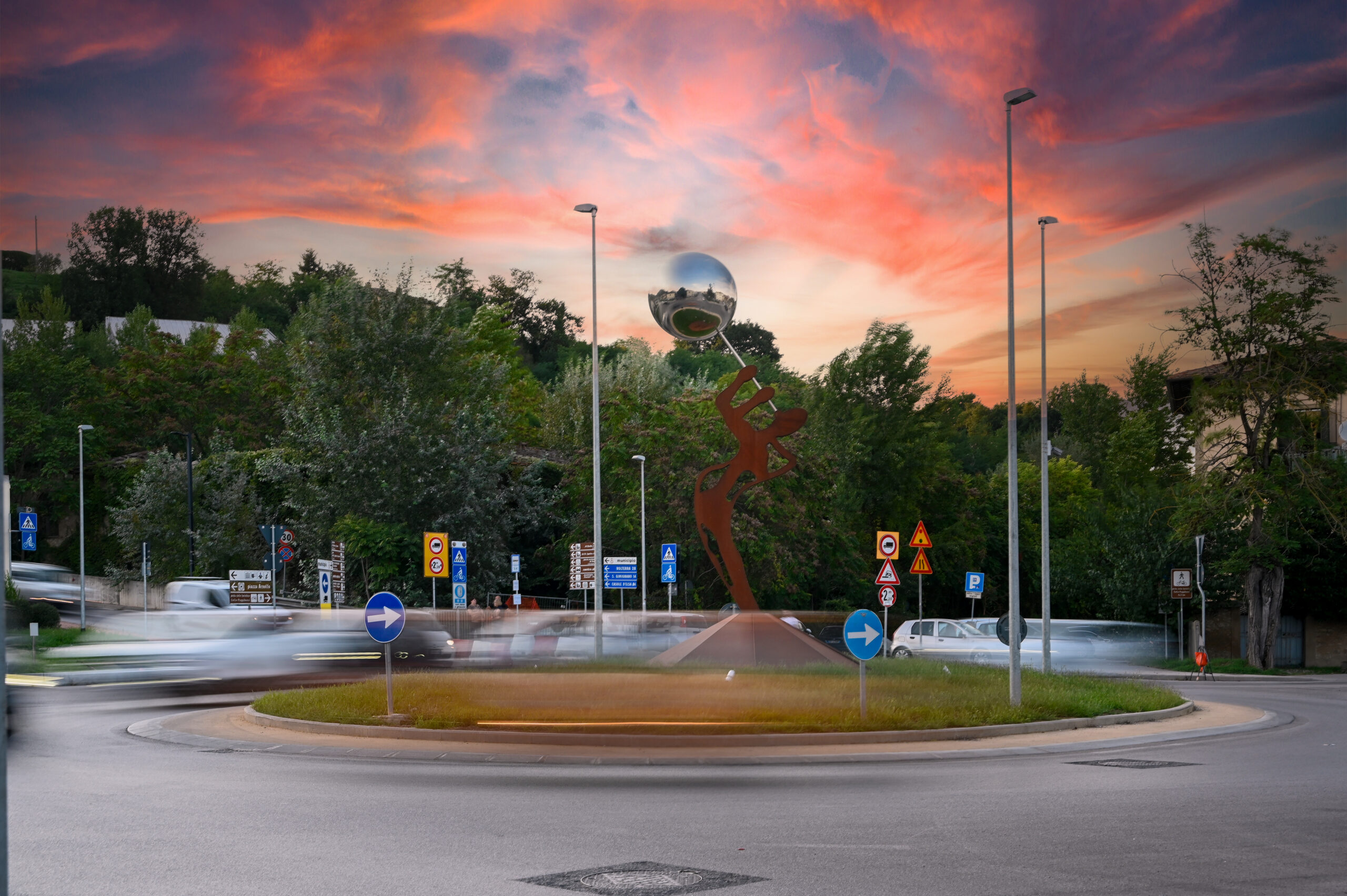
One of the ways in which this commitment takes shape is through the creation and progressive enrichment of an urban trail of contemporary works, featuring important installations specifically created for the town and perfectly integrated into its urban context. The Contemporary Art Project, interpreted in its role as public art, thus gives life to an original trail winding through the upper and lower parts of the town.
This evocative dialogue between art and ancient architecture, and contemporary installations, transforms the streets of the town into an open-air gallery that every visitor can admire.
The language of art transcends the centuries and connects different eras in a single, fascinating narrative.
Main works
Porta Nova – Tadashi Kawamata
In the past, the town gates had a defensive function; today, they are meant to be a symbol of welcome.
This is the message conveyed in 2004 by Japanese artist Tadashi Kawamata, who transformed the historic Porta Nova into a new work of art. In it, the beams and joints that make up the wooden structure remain visible, recalling the ancient defensive gates as a memory of time passing. At the same time, Kawamata’s work opens itself to a gaze that is able to see beyond, towards the world.
Cisterna – Marisa Merz
In 2002, Marisa Merz chose the ancient Renaissance cistern as the focal point of her intervention. A copper door, a warm and living material, becomes both boundary and invitation: a passage towards a mysterious interior, where water – a precious resource – is both protected and evoked.
UMoCA – Cai Guo-Qiang
Beneath the arches of the Bridge of San Francesco, Chinese master Cai Guo-Qiang created in 2001 a museum “suspended” between past and future: the Under Museum of Contemporary Art. Here, temporary exhibitions and installations engage in dialogue with the river and the town, making art an integral part of the urban landscape.
La Voce che si Indebolisce – Ilya Kabakov
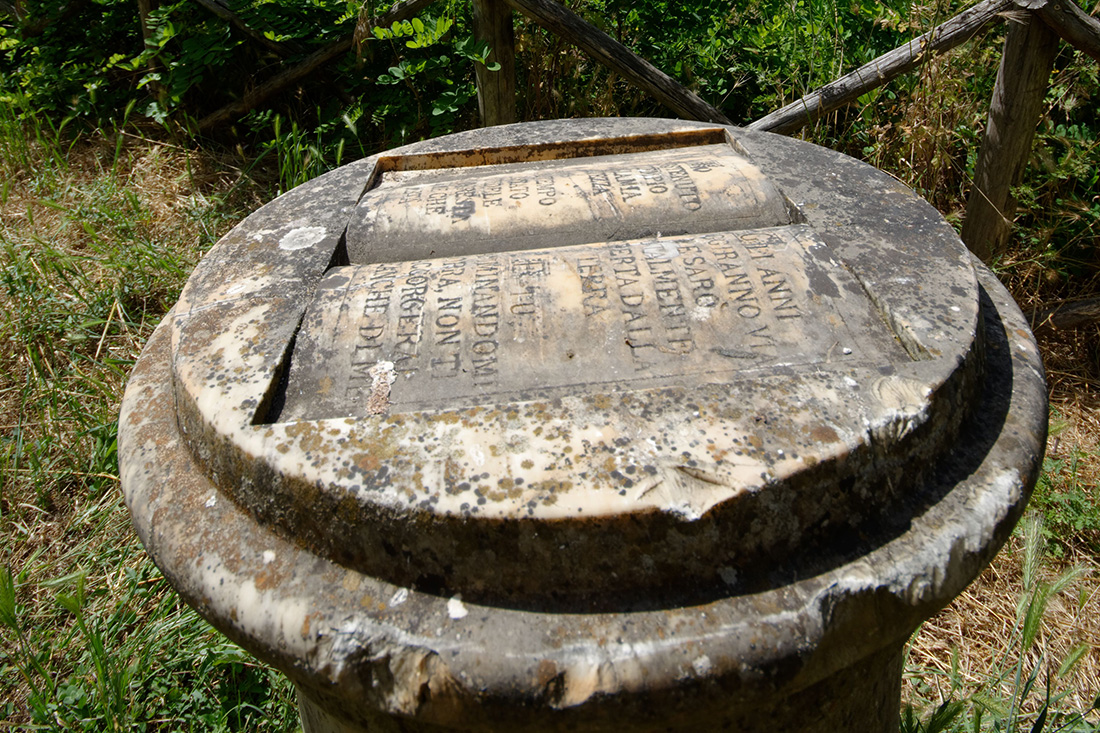
In 1998, beneath Bastione di Sapia, Ukrainian artist Ilya Kabakov concealed a marble column, almost buried, with an open book carved at its top. The engraved words speak of memory, inviting reflection on the passing of time, the oblivion of places, and the traces of those who lived there before us.
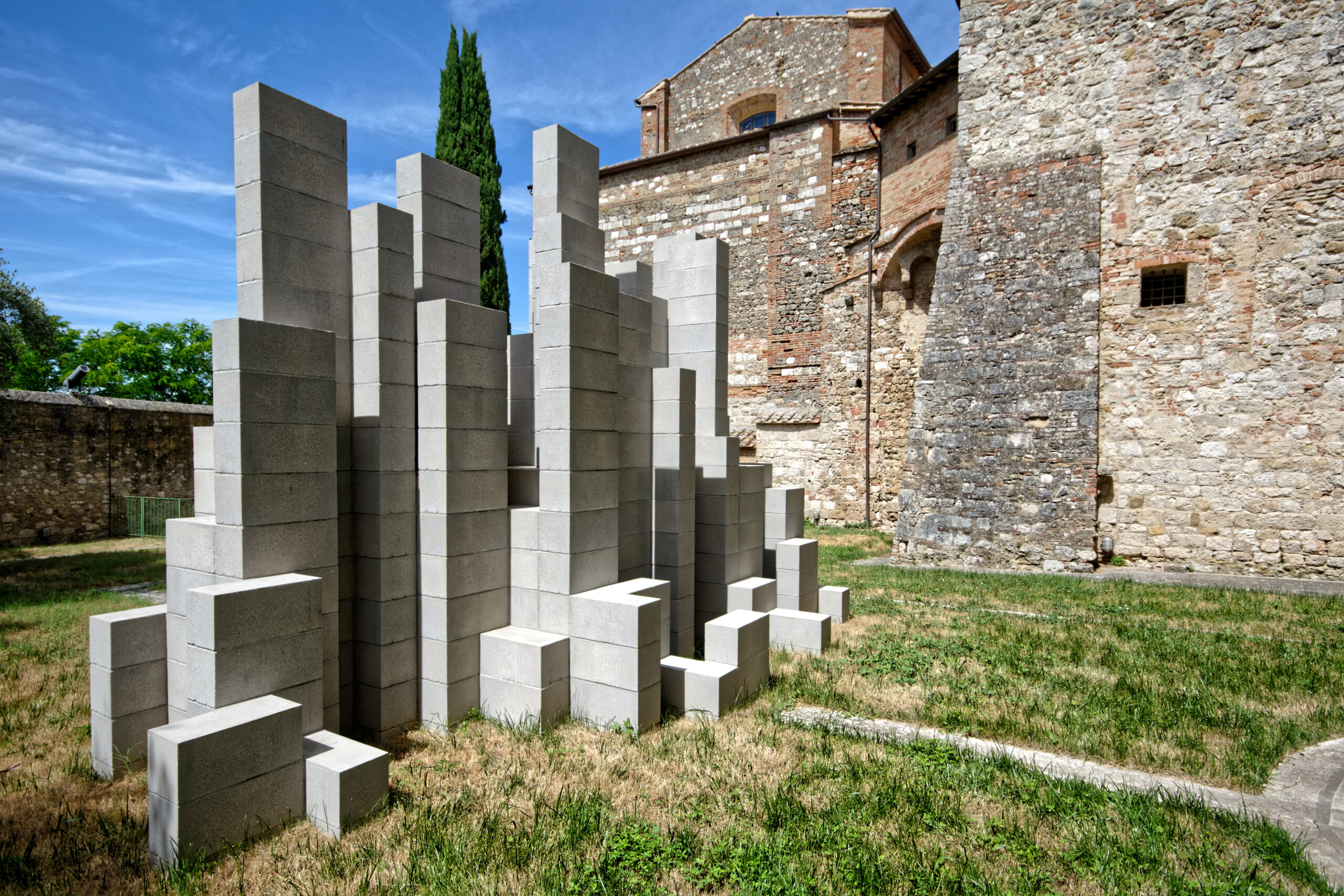
Concrete Blocks – Sol LeWitt
In 1997, Sol LeWitt conceived for the garden of Palazzo Pretorio, home to the Archaeological Museum, a work made of concrete blocks that recalls the skyline of Colle Alta and its lost towers. A tribute to the town and to manual craftsmanship, created from a simple raw material with powerful symbolism. In 2020, the work was permanently installed here as an important step in consolidating Colle’s contemporary art heritage.
Tears – Moataz Nasr
Created in 2002, the work was initially exhibited at the Crystal Museum. Following the inauguration of the Rooms of Memory inside Palazzo Pretorio, the work found its permanent home there, representing the sublimated and crystallised grief of those who are isolated and separated from their communities.
Red Girl – Kiki Smith
Among the artists invited to install their works in the spaces of UMoCA was the American artist Kiki Smith. The project, entitled Pause, displayed three young girls in a seated position (three, like the arches of the Bridge of San Francesco), made of white ceramic, intended to represent the moment of waiting experienced by women during the traditional wood gathering in Japan. Each girl, apparently identical to the others, was distinguished by the colour of her dress: red, yellow and blue. The sculptures were accompanied by crystal light bulbs, blown by the artisans of Colle. After the first exhibition, the three statues were placed in three different locations in the Valdelsa area.
The work Red Girl can now be visited inside the Archaeological Museum at Palazzo Pretorio, where it was recently relocated.
Facciata della Corale Bellini – Alberto Garutti
In 2000, Alberto Garutti brought new life to one of the buildings most cherished by the community, the home of the Corale Bellini. A restoration, but above all an artistic gesture conceived to give the town back a place of identity and shared memory. The Corale Bellini is located in the historic Via dell’Arringo, a connecting point between the two parts of the town.
Piazza Arnolfo di Cambio – Jean Nouvel
In 2009, Jean Nouvel and a team of international artists (including Bertrand Lavier, Lewis Baltz and Daniel Buren) redesigned Piazza Arnolfo, the heart of the lower town. Its paving, light features, water elements and furnishings together make the square a true open-air work of art, with the aim of restoring it as a central hub for the social life of the people of Colle.
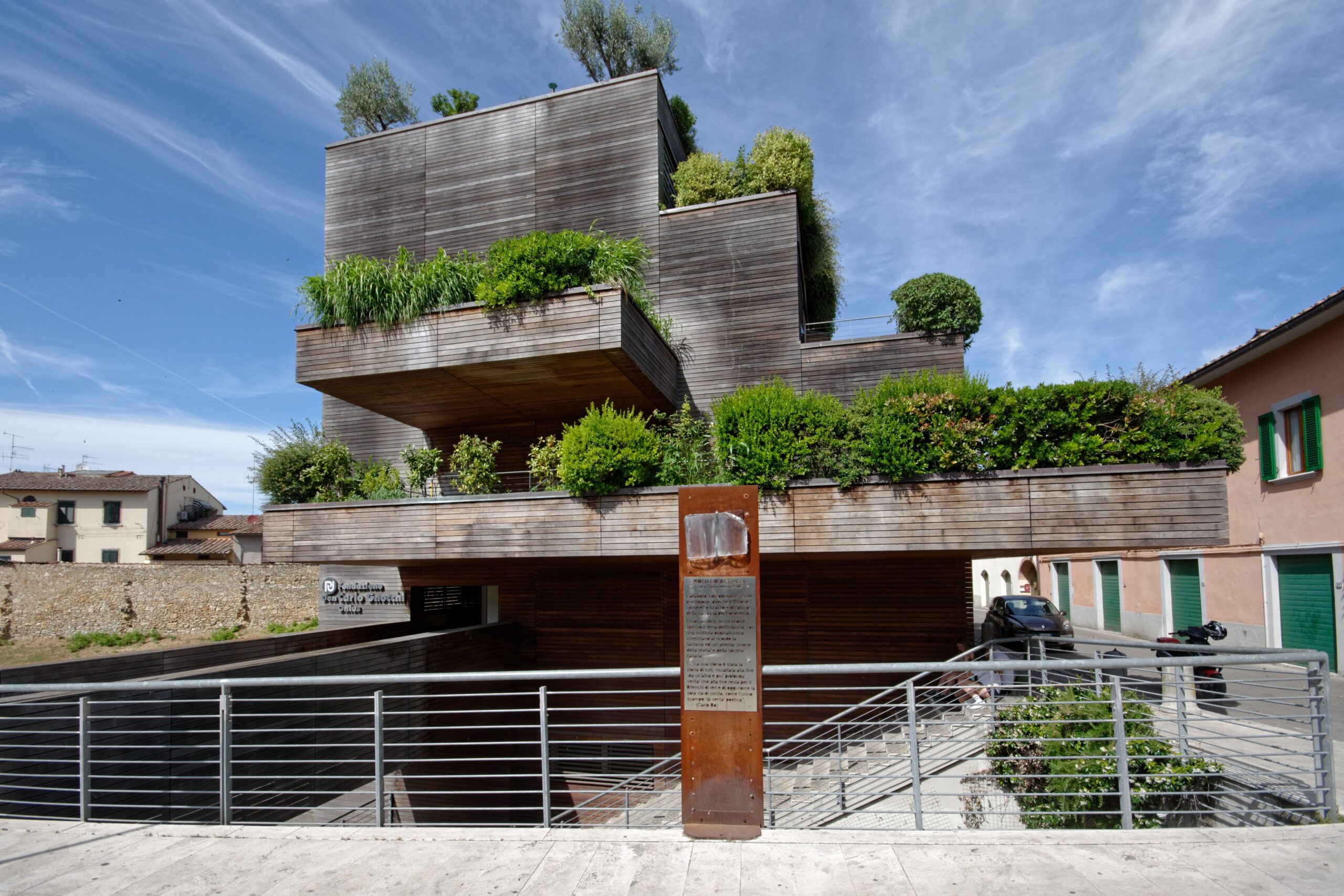
Edificio Ex Scalo Merci – Jean Nouvel
Together with landscape architect Gilles Clément, Jean Nouvel transformed the former railway yard into a multifunctional building. Today, the modern structure engages in dialogue with the surrounding greenery and houses residences, commercial activities and meeting spaces.
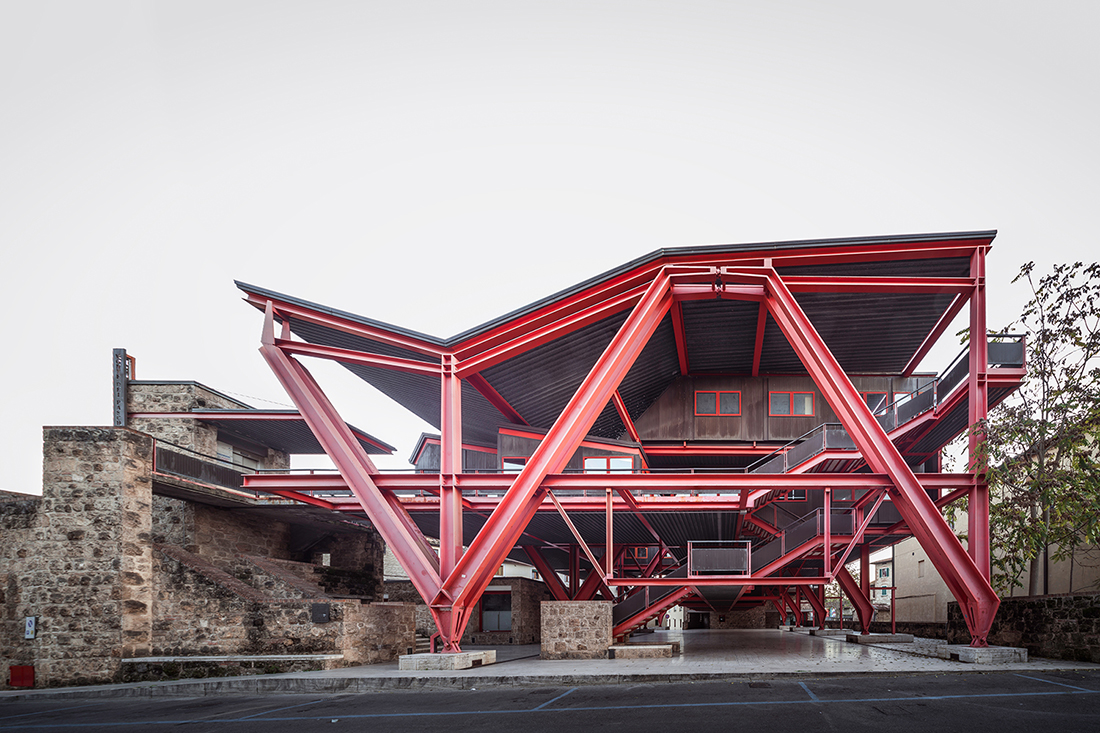
Banca Monte dei Paschi di Siena – Giovanni Michelucci
The bank, seen as a place of encounter and exchange: this is the particular idea that inspired architect Giovanni Michelucci in the design of the headquarters of Banca Monte dei Paschi di Siena.
On the ground floor, the building houses a multifunctional space known as Spazio MARS.
It is a bold structure, of great visual impact and symbolic value: set within the town’s historic urban context, yet reaching towards the future; its metal structures evoke the industriousness of factories, as well as a drive towards tomorrow.
Edificio SNR Casa della Musica – Loris Cecchini
In 2001, the year in which the space dedicated to young people and music was inaugurated, artist Loris Cecchini reinterpreted the building in light of its new function. From a warehouse used for marble processing, to a place of meeting and learning for younger generations; and finally to an auditorium designed to host musical projects.
“Nel Futuro Acceso/Spento” – Tobias Rehberger
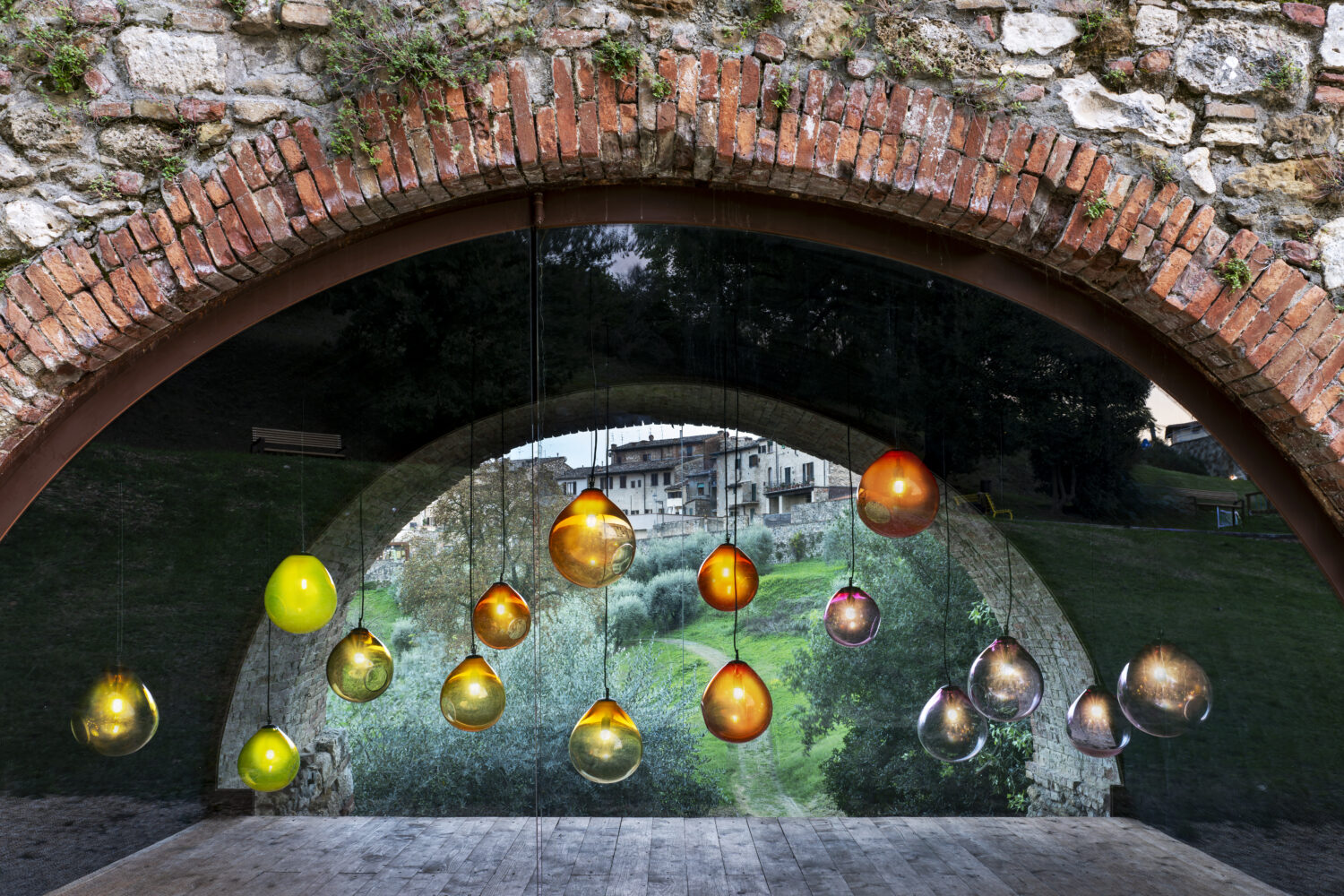
At the UMoCA – Under Museum of Contemporary Art, there is currently an installation by Tobias Rehberger consisting of 52 coloured crystal lamps suspended along the three arches of the bridge. The work, entitled In the Future On/Off, is part of the project Cities of the Future, organised by Associazione Arte Continua.
The work recalls, twenty-five years later, the installation Montevideo that the same artist created in 1999, on the occasion of the fourth edition of the project Arte all’Arte, also in Colle di Val d’Elsa.
To create this work, Rehberger proposed a series of lamps in three different shapes, all handcrafted by the specialised crystal manufacturer Collevilca of Colle di Val d’Elsa.
The choice of this material is a way of paying tribute to local tradition, while at the same time highlighting the temporality and transience of matter. Past and present are thus connected through a form of craftsmanship that invites visitors to engage with what stands before them, while also offering them the opportunity to interact with these handmade objects as they switch on and off.
The installation is controlled by the artist’s three children, who, through an app, decide when the lights will be on or off. This choice adds a poetic dimension to the temporal and participatory nature of the experience: a gesture that is also provocative, capable of symbolising an ideal passing of the torch from one generation to the next.
On a broader level, the combination of the material (the installation) and the symbolic (the artist’s act of handing over control to his children) inspires a reflection that invites the viewer to think along two complementary dimensions: the personal and the collective.